
Have you ever imagined what would happen if we asked a question to Generative AI platforms like ChatGPT, Gemini, and others, but the answers weren’t actually objective?
Instead of giving us the most accurate answer, what if these AI platforms started recommending brands or products simply because those brands had paid to be promoted?
Can you imagine how chaotic that would make the flow of information across the entire world?
Or perhaps AI platforms would simply lose their users because people no longer trusted them to be objective, knowing that their recommendations were openly biased toward advertisers who paid them?
Hi, I’m Willy Pujo Hidayat, and you’re listening to Commercesation, a podcast about eCommerce.
The Emergence of ChatGPT Ads
Around mid-September, the digital advertising industry was buzzing with excitement. Well, I’m not sure if it was just here in Indonesia, but people were definitely talking about it.
And no, it wasn’t because of the WhatsApp Business API update that introduced charges per delivered message. Although, yeah, that also caused quite a stir in early October.
This time, it was because of an email.
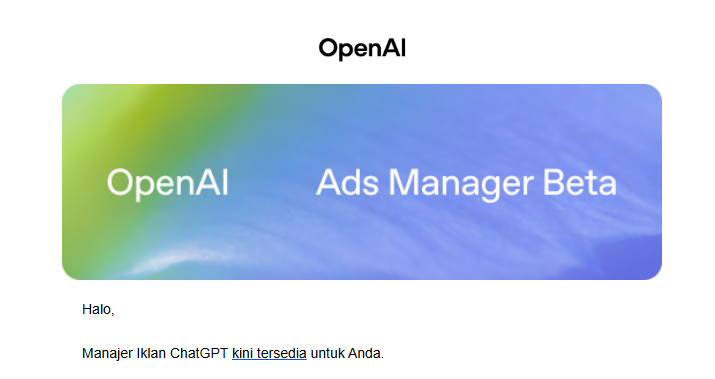
Yes, more specifically, an email from OpenAI officially announcing the OpenAI Ads Manager, although it was still in beta at the time.
And wow, everyone was talking about it. Both regular users and, especially, business owners.
When I first received that email, I was honestly a little shocked. I immediately felt a bit discouraged because it meant there was a whole new battlefield waiting for us: OpenAI Ads.
But then I stopped for a moment and thought:
“Wait a minute. Isn’t this a problem? Wouldn’t ChatGPT’s answers become biased once there’s advertising? What if it starts recommending products from brands that pay for ads?”
I got curious, so I decided to have a conversation with ChatGPT itself. 😀
I practically bombarded it with questions. Interrogated it, actually. 😀
And the answer was quite surprising. Really weird, if you ask me.
I asked something along the lines of:
“Wouldn’t your answers become biased once you start showing ads? What if you end up recommending products from advertisers instead of products that people actually need?”
Well, ChatGPT started clarifying things. 😀
According to ChatGPT, its answers would remain objective, and advertisements would be placed outside the actual answer box.
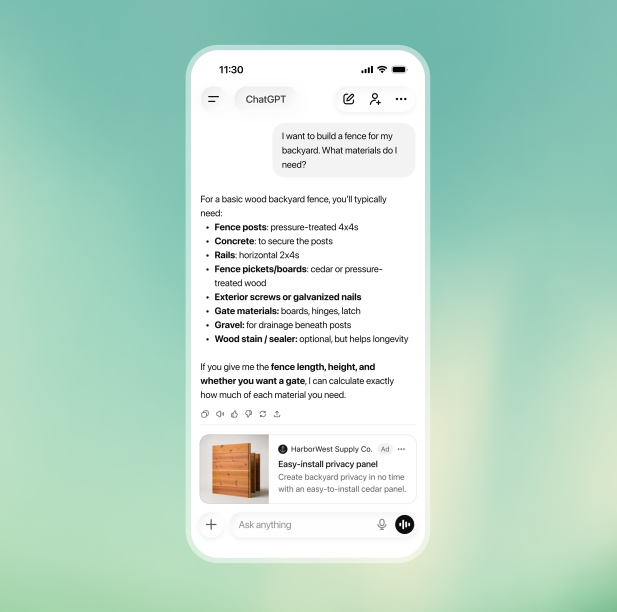
Isn’t that strange?
Imagine reading an AI-generated answer, and then, right at the bottom, there’s an advertisement.
That’s how ChatGPT Ads works, apparently.
And honestly, I find this advertising format really weird.
Then I thought:
“Well, maybe this is only for free users?”
Turns out, I got the ads too. 😀 Even though I’m actually a paying ChatGPT subscriber.
I was like, seriously?
However, at least I felt relieved knowing that the answers themselves would remain objective and wouldn’t be influenced by advertisers, since the ads were placed outside the answer box.
Generative Engine Optimization (GEO)
Long before OpenAI Ads came into the picture, there was already a pretty interesting conversation happening among digital marketers:
How can we get our brands recommended by AI?
Let’s say you sell sports equipment through an online store or even a physical retail store.
How do you make sure that when someone asks Gemini, ChatGPT, Perplexity, or any other AI platform for a recommendation, your brand actually shows up in the answer?
This has become a pretty interesting discussion, somewhere between speculation and empirical evidence.
Some people believe traditional SEO, or Search Engine Optimization, can still be applied. Others argue that the entire game has changed.
People have been debating and experimenting with ways to train AI systems to recognize their brands and include them in their recommendations.
Back in the day, with Google or traditional search engines, we could submit our websites through Google Search Console, let them crawl our pages, and gradually build credibility.
But how exactly does that work with AI?
That’s the big question.
Proof
In 2026, the business we manage has managed to bring its advertising expenses down to almost zero. Hopefully, that doesn’t sound like bragging. 😀
We used to spend tens of millions of rupiah on Google Ads. Now, our advertising expenses are practically Rp0.
Why do I say almost zero?
Because starting in October, Meta began charging per delivered message for the WhatsApp Business API. 😀
If that implementation were happening next year instead, our advertising expenses could literally be zero.
(I keep bringing this up, don’t I? I guess I’m still a little bitter about Meta. 😀)
Anyway, back to the point.
Our advertising expenses are now almost zero, and where does our highly converting traffic come from?
Yes, Generative AI.
In the past, customers would usually arrive as cold leads. Now, at least, they’re already warm leads, which means they’re probably around 50% ready to make a purchase.
In fact, this year, direct purchases through our website, without all the back-and-forth, have increased by more than 100% compared to last year.
And yes, we have tracking systems in place. So we can actually see that the highest conversion rate comes from a relatively new channel: Generative AI.
What does that tell us?
It means Generative AI is recommending our products, or our brand, to its users.
After trying to break things down, I think there are several factors that can help your website or brand get recommended by Generative AI platforms like ChatGPT, Gemini, and others.
And here they are.
OpenAI Ads and GEO Hacks (for eCommerce)
OpenAI Ads
Let’s start with some OpenAI Ads hacks.
Here’s my advice: Don’t use it just yet. 😀
Seriously!
I think the whole concept is quite strange. And naturally, people will recognize that it’s an advertisement and probably avoid it.
Unless, of course, the timing is absolutely perfect. In that case, there’s still a chance it might work.
But overall, my recommendation is to keep an eye on OpenAI Ads for now.
If I may share a little comparison, when Google first introduced Google AdWords, they tried really hard to make advertisements blend in with the actual search results.
They designed the ads to have a similar structure to organic search listings.
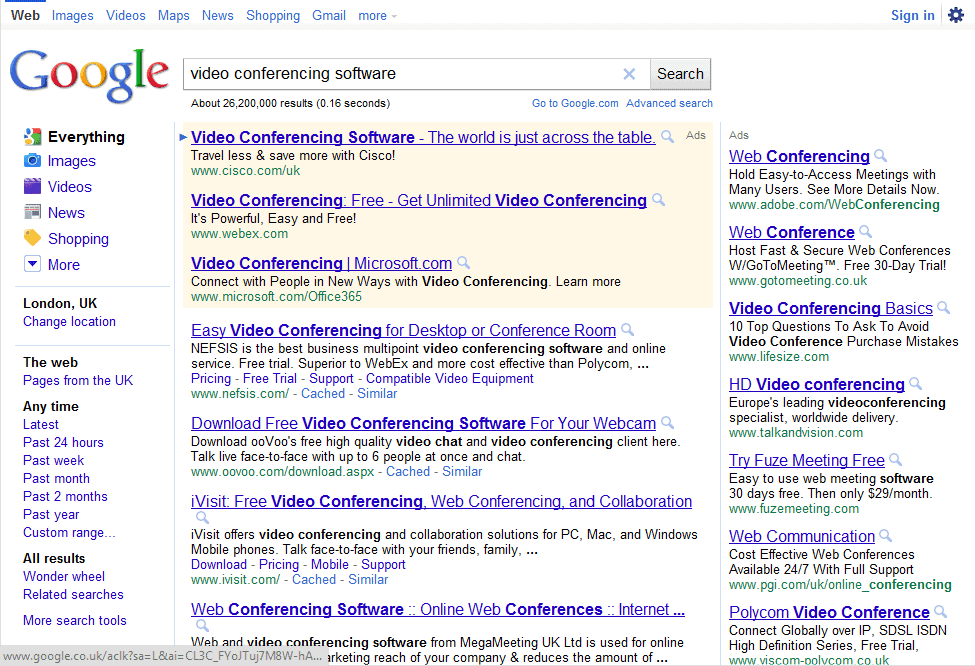
So, if you picked the right keywords, the results could be really good because your ads were given priority.
But look at ChatGPT Ads. 😀
However, there’s one thing to consider.
Every campaign has its own goals. If your objective is impressions or brand awareness, then I don’t think there’s necessarily a problem with experimenting.
That’s fair enough.
But if your goal is conversions, I’d probably hold off for now.
Seriously, it feels like a pretty strange advertising format.
My personal recommendation? Don’t use it just yet. Let’s focus on GEO hacks instead.
#1 GEO Hacks: Niche
If you’ve been listening to this podcast for a while, you might be getting tired of hearing me talk about Niche all the time. 😀
But that’s because it’s really, really important.
Similar to SEO, GEO also involves crawling, just like a spider exploring a website.
When an AI crawler visits your website, it can potentially:
- Go through all your website pages.
- Read all the content and text on your website.
- Observe visitor activities on your website.
- Even examine your website infrastructure.
Sounds scary, doesn’t it?
GEO can go much deeper than traditional SEO.
What does that mean?
You need to be focused. Define your niche, what you’re selling, what products you offer, who your target market is, and what kind of website you’re building.
Because eventually, AI will learn something like:
“Oh, so this is an online store specializing in sports equipment in West Jakarta.”
And it can go even further. It’s almost as if AI is conducting an assessment of your business and saying:
“Oh, this is an online store selling sports equipment. Quite comprehensive, actually. They sell everything from padel to badminton. They even have sports shoes. And look, quite a lot of customers are checking out directly on the website. No wonder. They’re using OpenCart, too. Interesting.”
With that kind of information, AI can provide much more specific recommendations and details about your business to its users.
So, the first GEO hack for eCommerce is Niche.
#2 GEO Hacks: Product Detail
After defining your niche, the next thing you need to work on is your product information.
You need to put more effort into making your product descriptions as comprehensive as possible.
Here are some standard attributes you should have in your online store:
1. Product Images
- Use good-quality product images, preferably from multiple angles.
- Use actual product photos. Whether it’s Google or today’s AI platforms, they love fresh content. So, keep feeding them new images and visuals.
2. Product Descriptions
- Some stores have both long descriptions and short descriptions. Make sure both are properly filled in.
- If you have complete technical specifications, even better.
For example:
- If you sell clothing, provide a size chart.
- If you sell shoes, provide a foot size chart.
- If you sell padel rackets, include dimensions, materials, and other relevant specifications.
3. Technical Specifications
This one is optional, but still useful.
For example, if different product variants have different packaging weights, make sure those details are available.
Or if there are different models, provide the specifications for each one.
4. Price and SKU
Just display your prices. That’s perfectly fine.
You don’t need to make customers go through the whole “DM us for the price” routine. 😀
Seriously, just put the prices on your website.
SKU information is also important, whether it’s your internal business SKU or the manufacturer’s SKU.
For example, if you’re selling a SONY headset, the model number or catalog number matters too. 😀
So, make sure you include as much detail as possible, all the way down to the SKU, if one is available.
5. Stock Availability
This can be quite important because some customers need products that are available immediately.
Imagine someone asking an AI:
“Can you find me a store that has Model A in stock? I really need it right now.”
If your website provides accurate stock information, that could make a difference.
Beyond these points, just make sure all the detailed product information is properly uploaded to your website.
Don’t do things carelessly!
If you have a large product catalogue, take your time and enter the information one product at a time.
After all, it’s a one-time effort. You don’t have to do this every month, do you?
Alright, let’s move on to hack number three.
#3 GEO Hacks: Business Detail
Some people have their own way of filtering businesses. They want to make sure that a business is actually legitimate because, well, nobody wants to get scammed.
That’s why it’s important to have dedicated pages on your website that provide detailed information about your business.
Your About Us and Contact Us pages shouldn’t just be there for the sake of having them!
Fill them in properly. Describe your business clearly and provide your phone number, email address, physical address, or even an address that’s connected to Google Maps.
If you have photos of your store’s exterior or storefront, make sure you upload those too.
Your business address, especially if it’s verified on Google Maps, can be very helpful for location-based searches.
For example:
“Find the nearest sports equipment store.”
That’s exactly the kind of search where having a properly verified business location can help.
#4 GEO Hacks: Social Proof
Since GEO has a much broader scope than SEO, because it needs to help AI answer all kinds of random questions from users, social proof becomes increasingly important.
Especially when we’re talking about Generative AI platforms that can read market trends in real time, such as Grok, which is connected to the social media platform X.
In that case, social proof becomes even more important.
What do I mean by social proof?
I’m talking about reviews and people’s actual experiences when interacting with your business.
You’ll usually find these on Google Reviews, X, Threads, or even Reddit.
So, every now and then, try searching for your brand name on AI platforms or Google and see what people are saying about your business.
Because GEO isn’t just about how AI engines learn from your website.
It’s about everything related to your brand across the internet.
Back in the SEO days, we could sometimes play around with backlinks, whether they were do-follow, no-follow, and so on.
But now, the crawling process is getting much more extensive.
#5 GEO Hacks (Bonus): Social Media Optimization
This last one is more of a bonus, in my opinion, because it’s optional.
And that is Social Media.
If you pay attention, you’ll notice that almost every social media platform now appears in Google’s search results.
YouTube videos, YouTube Shorts, Instagram, X, Threads, and even TikTok can show up in Google search results.
So, search engines like Google can read more than just captions and hashtags. They can potentially understand the actual content being spoken by creators in their videos.
And what about AI?
Even more so, right?
So, if your target market is active on social media, it’s important to maximize your social media content as well.
Again, GEO isn’t just about how detailed your website is.
It’s much more holistic. It’s about your brand’s overall reputation across the internet.
So, don’t just optimize your website. Work on your social media presence, too.
Conclusion
Alright, let’s recap all these hacks.
1. OpenAI Ads
My recommendation is to hold off on trying OpenAI Ads for now. 😀 Unless you have a lot of money to spend, in which case, well, that’s fine too.
2. GEO Optimization
Here are the five things you should focus on:
- Niche: Your business needs a clear and specific niche. Define what you’re selling, what products you offer, what activities happen on your website, and even consider your website infrastructure.
- Product Detail: This is extremely important. Provide as much information about your products as possible. Think of it as feeding AI with comprehensive product information so it can use that information when answering users’ questions.
- Business Detail: This is just as important. Make sure your business information is complete and credible. AI may also try to verify whether your business is legitimate and trustworthy.
- Social Proof: This one is somewhat outside our control, but make sure you have some social proof available. At the very least, start with Google Reviews.
- Social Media Optimization: AI doesn’t just analyze your website in great detail. It takes a much more holistic approach, looking at everything related to your brand across the internet. So, optimizing your social media presence is definitely worth considering.
Alright, that’s all the hacks for today.
Don’t forget to share this episode if you find it useful.
And don’t forget to follow and subscribe to this podcast on Spotify or YouTube.
Thank you for listening, and I’ll see you in the next episode!